
Are the New York City and New York state Cooling Tower Laws confusing you? You are not alone. We’re often asked which law applies to which location and when. While we cannot offer legal advice on how you should interpret the laws, we can offer you some assistance in navigating them for yourself.
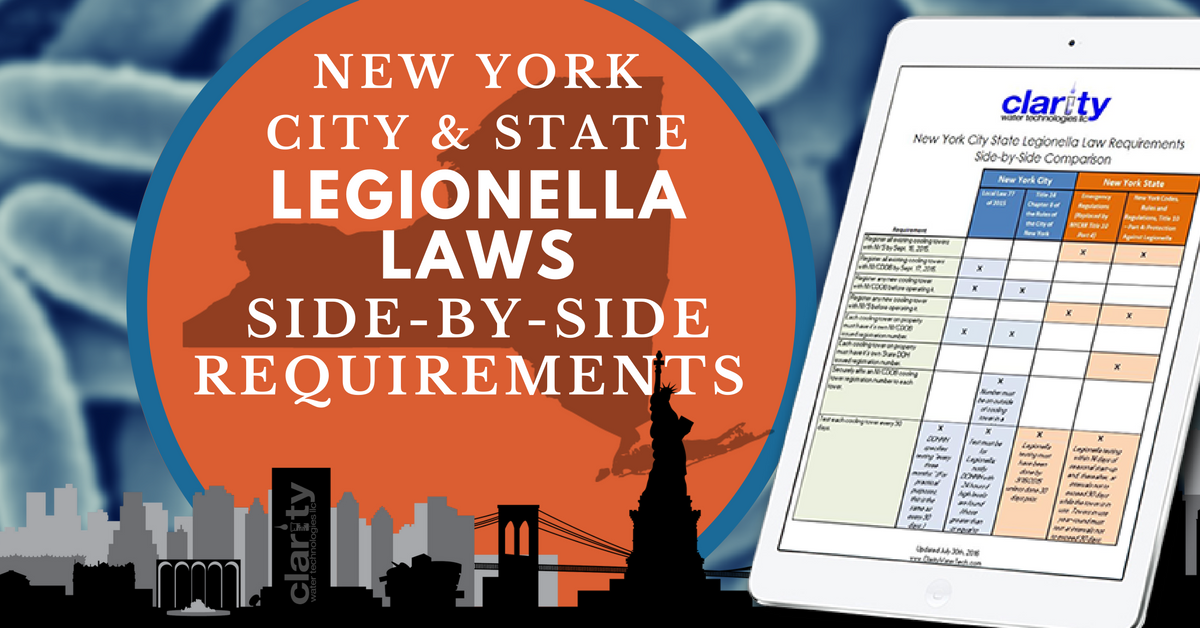
Below we have put together a side-by-side comparison of the requirements that have been laid out in New York City and state Legionella Laws and, in some cases, must be accounted for in your Legionella Maintenance Program and Plan (MPP). This simple to read chart is intended to help you and your team navigate the new legionella laws. Keep in mind: It is not intended to be a substitute for reading the actual laws.
Note: This article is provided for general informational purposes only and does not constitute legal, regulatory, or engineering advice. While Clarity Water Technologies strives for accuracy, no warranty is made as to completeness or applicability, and users are responsible for verifying current requirements before relying on or implementing any information. Clarity Water Technologies disclaims all liability for any loss or damages arising from use or reliance on this content, to the fullest extent permitted by law.
Why Do We Need Cooling Tower Laws?
Water treatment professionals have been warning about the dangers of legionella since the Philadelphia outbreak of 1976 that gave the legionella bacteria its name; a convention of the American Legion held at the Bellevue-Stratford Hotel. Those who were affected suffered from a type of severe pneumonia (lung infection) that eventually became known as Legionnaires’ disease. Since then Legionella has been suspected in thousands of lung infections and pneumonia related deaths throughout the United States; but not until 2015, almost 40 years later, has there been any sweeping laws passed to protect the public from illness or death caused by Legionella.
That all changed in New York City in the summer of 2015. By mid-July the New York City Department of Health and Mental Hygiene were aggressively investigation the source of a suspected legionella outbreak that would sicken 133 people and eventually claim the lives of 16 of them. Cooling towers capable of transmitting the bacteria were tested throughout the city, but the DOH had a problem; there were no easily accessible records of all the cooling towers in NYC.
Cooling tower water treatment and maintenance was not regulated in New York, or anywhere in the United States prior to July 2015; but New York City’s outbreak in the South Bronx called for legislative action. Both the New York City AND New York state initially passed emergency regulations to register and address all cooling towers throughout the city and dtate. By July of 2016, both New York City and New York state had passed sweeping cooling tower laws meant to protect the public and which carry severe penalties for their disregard.
In the summer of 2025, there was another outbreak of Legionnaires’ disease, this time in Central Harlem, that was linked to cooling tower systems of multiple buildings. Following this event, the City of New York enacted a new law and amendments to ensure public health and minimize the risk of Legionella transmission.
New York State has New York Codes, Rules and Regulations, Title 10 – Part 4: Protection Against Legionella which given its power by Statutory Authority: Public Health Law, section 225(5)(a). New York City Passed Local Law 77 of 2015 and codified its regulations with a new Chapter 8 (Cooling Towers) of Title 24 of the Rules of the City of New York. Most recently, the City passed Local law of 2025, along with subsequent amendments to Chapter 8 of Title 24 that went into effect on May 8, 2026.
American Society of Heating, Refrigerating and Air-Conditioning Engineers (ASHRAE) Standards for Controlling Legionella
The American Society of Heating, Refrigerating and Air-Conditioning Engineers (ASHRAE) published a standard that establishes the minimum legionellosis risk management requirements for building water systems. While a standard is not a law, it does provide public guidelines that buildings throughout the United States can incorporate it into their bylaws and regulations. In fact, ASHRAE Standard 188 is specifically named as a resource in both the New York City and state cooling tower laws.
The New York City & State Legionella Law Side-by-Side Comparison Chart
The City and State laws are similar but do have some significant differences. To help you understand these differences, we have put together a side-by-side comparison of the major requirements. You may download our free side-by-side chart below.
Please note: This is not a legal document and we are not offering any legal advice. It is important that you read the city and state laws for yourself and, if appropriate, seek the guidance of qualified professionals to determine the proper steps that you need to take in order to stay in compliance with the law.
If you need assistance in New York City or state with your cooling tower testing, water treatment, disinfection or Maintenance Program and Plan (MPP), please do not hesitate to contact us!
Good luck and thanks for reading! Here’s your link:

